
Most of us get into the home business world for one primary reason: Freedom. We wanted to break away from the 9-to-5 grind, reclaim our time, and build an income that didn’t require us to be chained to a desk. But for many online entrepreneurs, that “desk” has simply been replaced by a smartphone screen.
Me and my phone have a very real love/hate relationship. So the less I spend on my phone, the better.
That’s a big reason why I love SEO. It’s not quite “set it and forget it,” but it’s close to it! Let’s dive in and see why…

The Content Hamster Wheel
If your daily routine involves posting three times a day on Facebook, recording five Reels for Instagram, and dancing on TikTok just to stay “relevant” in an algorithm, you haven’t found freedom—you’ve found a new, high-intensity job.
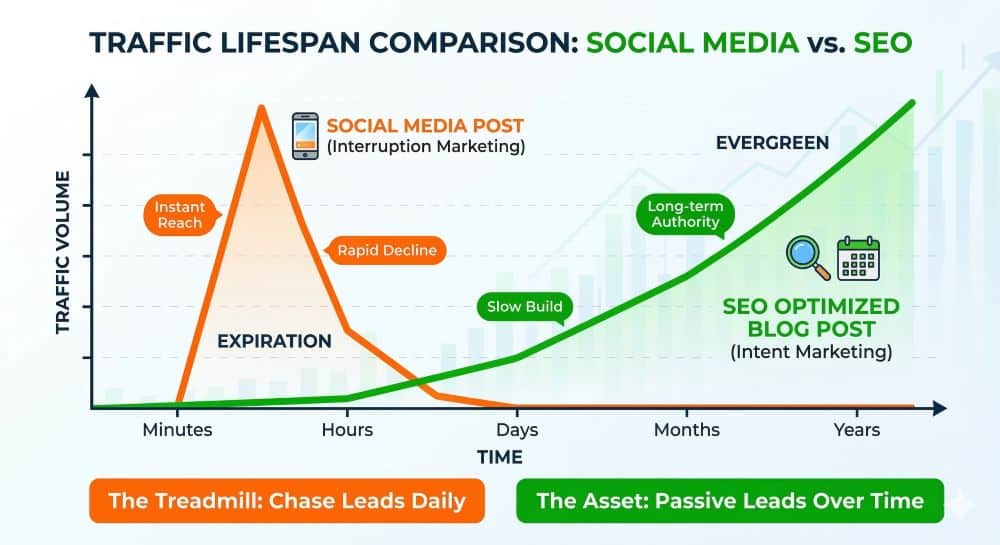
The problem with social media is its half-life. A post on some of these platforms lasts about 18 minutes. A Facebook post survives for a few hours. After that, your hard work disappears into the digital abyss, and you’re forced to start over at zero the next morning. It’s a treadmill that never stops, and if you stop running, your leads stop coming.
Okay, slight caveat. If you love doing these things, then don’t let me talk you out of it! Haha. By all means, keep going! But I hope to share some alternatives for you.
In fact, you don’t have to choose one or the other at all! Varying your marketing strategy is important. And if marketing is new to you, it might be simpler than you think!
SEO isn’t a marketing trick, it’s a wealth-building principle that many entrepreneurs miss!
The Power of Search Intent
There is a fundamental difference between Interruption Marketing and Intent Marketing.
- Social Media is Interruption: You are trying to grab someone’s attention while they are looking at photos of their nephew or a cat meme. You are an uninvited guest.
- SEO is Intent: When someone goes to Google and types in “how to generate leads for a home business,” they are literally raising their hand and asking for help. They have a problem, and they are looking for you to be the solution.
The Big Idea: Content that Works While You Sleep
Imagine if a piece of content you wrote two years ago was still bringing you fresh, qualified leads today—without you having to boost it or share it again.
That is the power of SEO. It’s the shift from being a “chaser” to becoming a “magnet.” Instead of shouting into a crowded room hoping someone hears you, you’re simply placing a sign-post exactly where people are already looking.
Why SEO is the Missing Link for Your Home Business
If you’ve been in the home business or network marketing space for any length of time, you know that leverage is the name of the game. You want to do the work once and get paid for it over and over again.
So, why are we treating our content differently?
Most entrepreneurs treat their content like a consumable—you post it, it gets consumed, and then it’s gone. SEO allows you to treat your content like an asset. Here is why it’s the missing link in your strategy:
1. Evergreen vs. Expiring Content
Think of a social media post like a newspaper; it’s yesterday’s news by tomorrow morning. A search-optimized blog post, however, is like a library book. It sits on the shelf, indexed and organized, waiting for the exact moment someone needs that specific information. That’s evergreen content!
Whether it’s six months or six years from now, if someone searches for the solution you provided, your “book” stays relevant. That is the definition of leverage.
2. The “Pre-Qualified” Lead
On social media, you are often fighting through scrollers who aren’t in a buying or joining mindset. They are there to be entertained.
When someone finds your blog through a search engine, they have Search Intent. They are actively looking for a way to make money online, a way to save for retirement, or a way to escape their boss. By the time they land on your page, half the “selling” is already done because they sought you out.
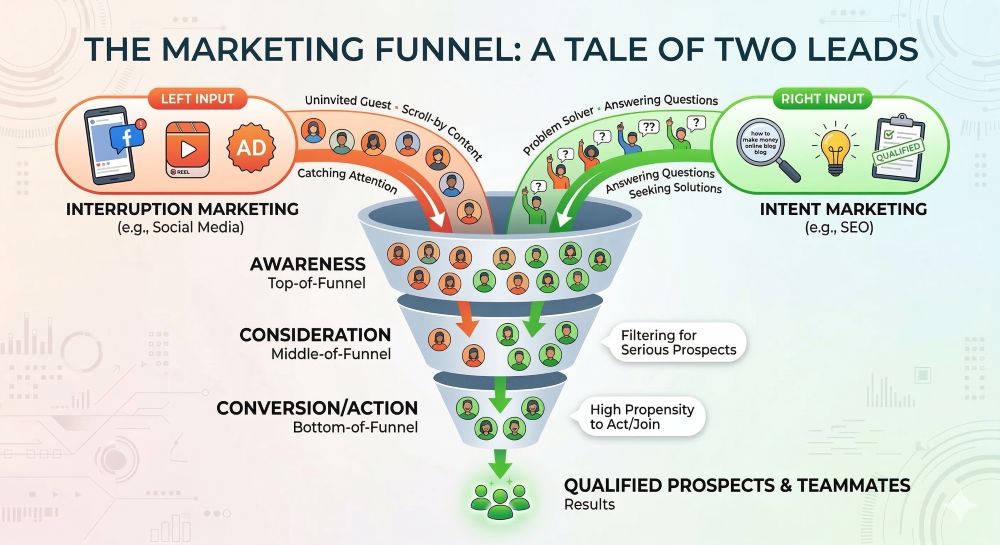
Unlike social media, SEO brings leads into your funnel who are already looking for a solution.
3. Instant Authority & The Expert Factor
There is a psychological shift that happens when a prospect finds you on the first page of Google. They don’t just see a “marketer”—they see an authority.
Ranking for key terms in your niche builds an immediate layer of trust that cold messaging or “commenting for reach” can never replicate. You aren’t just another person in their DMs; you are the person Google recommended as a solution to their problem.
4. Building Your Own “Land”
We’ve all seen it happen: a social media platform changes its algorithm, shadows-bans an account, or disappears entirely (remember MySpace?). When you build your business solely on social media, you are building on rented land.
A blog is land you own. SEO is the fence you build around that land to ensure that no matter what happens to Facebook or TikTok, your lead flow remains within your control.
What I really want to do is demystify SEO. I think a lot of people in the home business niche avoid it because they think they need to be a tech genius or a coder or don’t think it will work for them.
I’ll break it down into three simple, results-driven steps that any entrepreneur can follow.
The 3-Step “Home Business SEO” Framework
SEO isn’t about tricking Google or writing for robots. It’s simply about being the most helpful person on the internet for a very specific group of people.
Google has an entire document on creating helpful, reliable, people-first content, so you know it must be important!
Here is the framework I use to turn a blank screen into a lead-generating machine.
Step 1: Find the Pain Point Keywords
Stop trying to rank for massive, generic terms like “Make Money Online.” You’ll be competing with giants and lots of sponsored listings. Instead, go where your ideal teammates are already hanging out—in the specifics.
Think about the questions your prospects might ask you every day:
- “How do I get leads without cold calling my friends?”
- “What are the best side hustles for stay-at-home parents?”
- “How do I stay motivated when my business feels stuck?”
When you target these “Long-Tail Keywords,” you aren’t just getting traffic; you’re getting qualified prospects who are looking for exactly what you have to offer.
Step 2: Create Value-First Content
Google’s only job is to provide the best answer to a user’s question. If you want to rank, your job is to provide that answer.
You don’t need to be a Pulitzer Prize-winning author. You just need to be helpful.
- Use clear headings so people can skim.
- Share a personal story or a “lesson learned”.
- Give them a “quick win” they can implement immediately.
When a reader gets value from your post for free, the natural next question they ask is: “If this is what they give away for free, what is their paid solution like?”
Step 3: The Bridge (Your CTA)
Traffic is a vanity metric; leads are a business metric. Every SEO post you write should serve as a bridge to your next step.
Instead of a generic “Sign up for my newsletter,” use a specific Call to Action (CTA) that matches the topic of your post. If you wrote about generating leads, your CTA should be: “Ready to see the automated system I use to get leads 24/7? Join the HBA here.”
By aligning your post topic with your offer, you create a seamless transition that feels like a natural “next step” rather than a sales pitch.
This transition is the secret bridge to marketing paradise that allows you to attract dream partners instead of cold prospects (Listen to episode 3!)
Avoiding the Tech Trap: Why You Don’t Need to be Techie
One of the biggest reasons home business owners shy away from SEO is the “Tech Trap.” They assume they need to understand HTML, CSS, or complex algorithms to get noticed.
Here’s the truth: Google doesn’t rank code; it ranks answers.
1. You Don’t Need to Be a Techie
Modern blogging platforms (like WordPress) do 90% of the heavy lifting for you. If you can send an email or post on Facebook, you have the technical skills required to write an SEO-optimized post.
Focus on the message, not the metadata. If your content is genuinely helpful and uses the words your audience is searching for, the “tech” side will largely take care of itself.
Is there more to learn than that? Certainly! But you don’t have to make it a barrier or limiting belief that stops you from just starting!
2. Consistency Over Complexity
You don’t need to publish a 5,000-word masterpiece every day. In fact, that’s a recipe for burnout.
SEO success for a home business owner comes from consistent, targeted effort. One high-quality post per week—focused on a specific problem your audience faces—will do more for your bank account over the next few years than 100 random “motivational” posts on a social media feed.
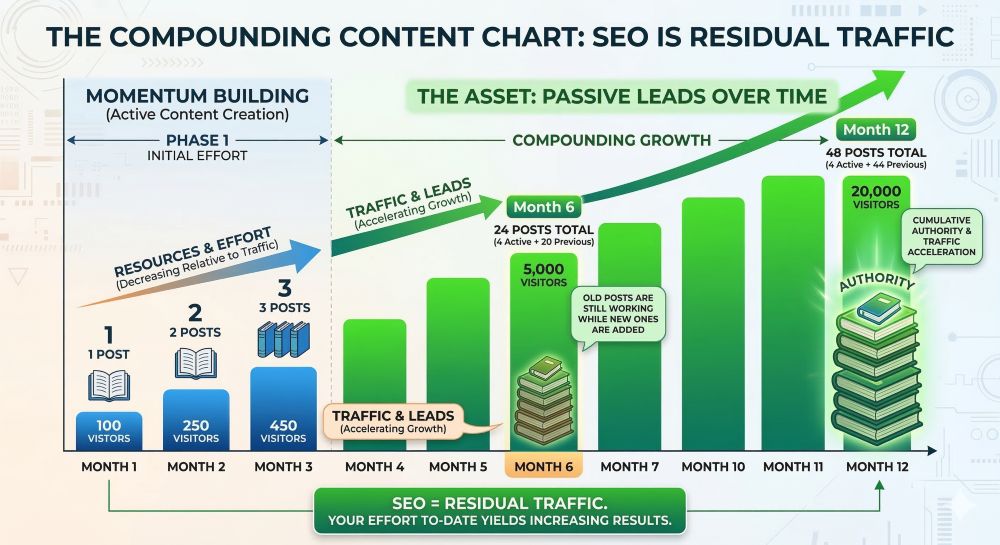
This chart shows an example of what happens with SEO’s residual traffic potential. Just remember that every website is different and so is your experience with it. You might rank quickly, but sometimes it can take up to 6-12 months before you start to see real traction and results.
3. The Slow and Steady Secret
Social media gives you a spike of dopamine and then a crash. SEO is a slow-burn wealth strategy. While it might take a few weeks or even months for your first post to start gaining traction, that traction is cumulative. Every post you write is like adding another salesperson to your team who works for free, never sleeps, and never calls in sick. Over time, these posts aggregate into a massive traffic engine that runs entirely on autopilot.
Your 24/7 Digital Recruiter
At the end of the day, building a home business is about leverage. You want your time back, and you want your message to reach the people who are actually looking for what you have.
You can keep shouting into the void of social media, hoping the algorithm chooses you today, or you can start building an asset that grows in value every single month. SEO isn’t just a “traffic strategy“—it’s a way to ensure that your business works for you, even when you aren’t working on it.
Stop Chasing, Start Attracting
If you’re tired of the “hustle” and ready to build a Silent Lead Machine that brings pre-qualified prospects to your doorstep, it’s time to move from “scrolling” to “searching.”
Let’s stop renting our traffic from social media and start owning our results. See you at the top!
Becca Newton helps home business owners build “Digital Real Estate” through simple SEO strategies. A firm believer in working smarter, not harder, she teaches entrepreneurs how to get Google to do their recruiting for them. Get her latest book, “The SEO Survival Guide” here.
One nuance that tripped me up early on: ‘evergreen’ doesn’t mean you never touch it. Pages that rank well do need periodic refreshes to keep accuracy and freshness signals intact — but that’s still way less work than a daily social media treadmill.